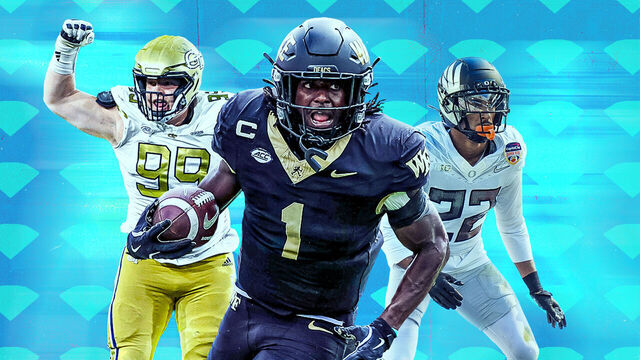
Teams that can consistently find value on Day 3 of the NFL draft tend to set themselves apart in the long run. Now that we're familiar with the top talents available in this year's class, let's dive into some under-the-radar prospects.
Here are 20 players worth a swing in the later rounds of the 2026 draft.
You've probably heard by now that this isn't the best year to be looking for a quarterback. While the hit rate on Day 3 passers will always be low, it's almost always worth a shot for a team to see if it can strike gold. That's especially true if you're taking a chance on a player with Green's upside.
The Arkansas product has a long way to go to improve his accuracy, processing speed, and timing. However, he's got plenty of arm, and a sensational combine performance (4.36 40, 43.5-inch vertical) cemented his status as one of the most athletic quarterback prospects we've ever seen. If it all comes together with a few years of development, we could be looking at a dangerous dual-threat passer. If not, Green's rare physical gifts might give him a chance to follow the Logan Thomas/Terrelle Pryor route and carve out a career at another position.
We're sticking with the unteachable traits for the second quarterback on this list. Any team drafting Allar will have to be prepared to play the long game. Though he was once considered a potential first-round prospect in this 2026 class, his development never took off before an injury-shortened senior season. As things stand, Allar just isn't ready to be thrown into an NFL game.
If he's going to change that trajectory, Allar will have to clean up his mechanics, improve his accuracy, and address his processing and decision-making issues. It's a long shot, but hey, that's why coaches get paid, too. With a big body, impressive arm strength, and stellar athleticism, Allar has the physical gifts that'll always be worth a gamble on Day 3. If he can land with a team capable of developing the rest of his game, who knows?
Claiborne could be on the board well into Day 3 since he won't be for everyone. The Wake Forest playmaker doesn't have the frame or physicality to be a high-volume feature back, and he'll need to develop as a receiver and in protection if he's ever going to provide any value in the passing game.
While there aren't many examples of undersized runners who contribute only on early downs, teams would be wise to see if they can make it work with Claiborne. His combination of high-end speed, lateral quickness, and creativity puts him up there with the best in this class when it comes to big-play upside. The key is finding ways to get the ball in his hands and watch him go.
Stewart isn't the biggest running back, and he's not the most spectacular athlete. And with nine receptions across five seasons in college, you probably can't expect much from him in the passing game. He'll also have to clean up issues with ball security. All that said, I'm not sure I've ever seen a ball carrier break tackles like this.
Stewart has the lateral quickness and creativity to make defenders miss with ease. His low center of gravity and balance also allow him to effortlessly bounce off weak contact, while his power lets him run through opponents. Although Stewart's unfathomable missed-tackle rates (100th percentile over the last three years, according to PFF) will likely drop in the NFL, we're talking about Day 3 draft capital or even a priority free agent signing here. I'd happily take a swing to see how much of this unique skill set can carry over.
Coleman isn't getting nearly enough attention as part of this year's receiver class. His 5-foot-10, 179-pound frame could present some issues at the next level, but he's much stronger than you might expect at the catch point, hauling nine of his 11 contested targets in 2025.
While Coleman might have trouble translating that success in the NFL, that's not his game anyway. His quickness at the top of routes allows him to create easy separation, and he shows off his shiftiness when he becomes a playmaker after the catch. Coleman's value as a slot receiver who also contributes as a return man on special teams could quickly help him outplay his draft position.
McAlister is likely a Day 3 prospect because he turns 24 during his rookie season and has an off-field history that needs to be part of any team's evaluations. If we're talking solely about on the field, though, McAlister's talent stands out. He provides an incredibly appealing blend of size, explosiveness, and run-after-catch upside, making him the type of player who should be generating plenty of interest in the middle rounds.
Not only can McAlister erase pursuit angles in the open field, but his physicality as a runner allows him to bounce off defenders regularly. He tied Omar Cooper Jr. for first in this receiver class with 27 missed tackles forced while leading the position group with 375 yards after contact, according to PFF. McAlister has room to improve as a route-runner and to better maximize his size in contested situations, but his unique ability with the ball in his hands provides an impressive floor. He has potential if NFL coaching can help him round out the rest of his game.
Boerkircher is arguably the best run-blocker in his position group. He's the rare tight end prospect who should be able to hold his own as an in-line player from Day 1, and he's effective climbing to the second level to take care of linebackers. Those skills should get him on the field early in his pro career.
From there, he'll have the opportunity to tap into his underrated upside as a receiver. The Texas A&M offense never really took advantage of his skill set, but Boerkircher has strong hands, sneaky quickness at the top of his routes, and impressive physicality after the catch. He's certainly one to watch on Day 3.
Koziol may never be the type of tight end a team can expect to create separation at the top of his routes consistently. If he can keep dominating contested situations as he did in college, it won't really matter. Using his 6-foot-7 frame and strong ball skills, Koziol routinely rises to make one play after another.
In 2025, Koziol hauled in 17 of 23 contested-catch opportunities, good for a gaudy 73.9% success rate. If he can continue to get stronger and leverage his size and length as an in-line blocker, he could be quite the weapon for an offense that looks to attack opponents out of multiple tight end sets.
Parker seems likely to follow in the footsteps of Graham Barton, another former Duke offensive tackle who transitioned to center at the outset of his pro career. While he may not be on that level as a prospect, I don't see why he can't find similar success.
Parker is a good athlete whose movement skills should play up with a shift to the inside. He's not the most powerful force, but he compensates by playing with sound technique and the tenacity to work through the whistle. He could end up as an early starter for an offense that leans on zone run concepts.
Gennings Dunker and Logan Jones have received most of the attention among Iowa linemen in the pre-draft process. Don't sleep on the third player in the Hawkeyes' trio of big men jumping to the next level. Stephens will have to prove that his lack of length won't hinder his ability to anchor against power. Even among guards, his 31 1/8-inch arms are in the first percentile.
But Stephens was a steady presence in pass protection in college, giving up just 11 pressures and no sacks across the last two years. His heavy hands and tenacious play style consistently generated plenty of movement off the ball in the run game. While he doesn't test like a high-end athlete, Stephens' lateral movement skills allowed him to thrive in Iowa's zone-blocking scheme. He can provide starting potential in a range of the draft where teams are mostly searching for depth.
Williams' approach is everything you're looking for in the type of player who's going to outperform his draft position. The Duke product plays with an incredible motor, fighting to the whistle on every rep. Still, effort is only one part of his game.
He also wins with strength, good hand usage, and awareness to anticipate and defeat blocks. A lack of upfield burst might limit his upside coming off the edge on late downs, but Williams could be a base end who makes his impact in the run game and rotates inside in sub packages.
James-Newby ranked third in the nation with 66 pressures last year, trailing only David Bailey and Rueben Bain Jr. Although he was one of the most productive edge rushers in the country, James-Newby might not have the size to set the edge in the NFL, and the jump in competition from the Mountain West will have some questioning whether his pass-game skills can translate.
However, with explosiveness off the ball, good hand usage to keep opponents at bay, and an impressive motor, James-Newby absolutely offers upside as a situational rusher. Given the time to further develop his arsenal, he should be able to get after the quarterback at the pro level.
Speaking of athletes, Van Den Berg is the type of high-upside swing that teams want to take later in the draft. The production profile is admittedly underwhelming, and he's already 24, but those factors are likely baked into the acquisition cost. The Georgia Tech standout is a sensational athlete who posted the second-best Relative Athletic Score among defensive tackles since 1987.
Van Den Berg's unique movement skills are evident in his ability to explode into the backfield and beat his opponent to spots laterally. Unlike most top athletes at the position, he also plays with the kind of natural power that makes him difficult to move off the ball. Van Den Berg can be an every-down player at the three-technique spot if NFL coaching helps him maximize his rare physical traits.
Regis is quite a bit smaller than your average nose tackle at 6-foot-1 and 291 pounds, which raises questions about whether he can translate his run-stuffing prowess to the next level. But with an impressive combination of power and technique, he's still incredibly difficult to out-leverage and move off the ball. He also has the lateral movement skills to beat opponents to their landmarks.
The run-game production alone would give Regis more than enough value for a team to select him at some point in the middle rounds. After running a 4.88 40-yard dash and posting elite jump scores for the position during an outstanding combine workout, I'm wondering if he may have some untapped pass-rush upside. Regis pairing his well-established abilities in the run game with occasional pressure production would make him a steal on Day 3.
Rolder didn't get much experience at the college level, starting just 11 games over his four-year career at Michigan. Yet you wouldn't know it from the instincts he demonstrated when he finally got on the field consistently.
Rolder processes the run game at a high level, plays with the physicality to take on blocks, shows good speed in pursuit, and is an excellent tackler. More development will be required to find similar success in the pass game, but there were enough flashes that suggest he can hold his own with more reps. Rolder offers clear starting potential on Day 3.
Kelly is the kind of player who will help your defense get off the field on third down. While he needs to improve his processing skills in the run game, he's capable in coverage and, most importantly, can make an impact as a pass-rusher.
Whether blitzing from the second level or occasionally rotating down to the edge, Kelly used his skills to rack up eight sacks and 28 pressures in 2025. A defensive coordinator who can weaponize that skill set, and perhaps maximize his pursuit speed and motor in spy duties against mobile quarterbacks, will get an intriguing chess piece.
Canady will have his share of doubters based on size alone. At 5-foot-10, 181 pounds, he's certainly on the small side for any position in the secondary. And with teams slowly trending toward big nickel defenders in the slot, that role is no longer an obvious solution. Still, smart organizations will find a way to get a player with these kinds of coverage traits on the field.
Canady plays with impressive fluidity and short-area quickness. Those movement skills, along with outstanding route anticipation, allow him to match a receiver's breaks seamlessly. His instincts for the game also show up with the way he'll jump routes in zone, and he's a playmaker at the catch point. Additionally, Canady punches above his weight class as a tackler. Someone will end up getting a really good football player at a discount if evaluators overthink the measureables.
Going from FCS football to covering the best wide receivers on the planet, Demmings will be in for a monumental jump in competition. It's a big ask, but there's reason to believe he can contribute on Sundays. His outstanding combine numbers confirmed his explosive athleticism, and he's not just a workout warrior.
Demmings has the fluidity to provide sticky coverage out of press-man alignments. He also brings strong ball skills to make plays at the catch point, and he adds physicality in run support. With some time to develop and a system that takes advantage of his man coverage skills, Demmings could compete for a role early on.
Huskey cracked the top 10 in my safety rankings, but he's also worth highlighting here based on his expected draft position. His absence from consensus big boards is likely due to his average athletic profile, and he may not be a fit for every role in the secondary.
Still, I see Huskey as an instinctive player whose processing skills tend to compensate for any range he may lack. He's also a much more physical player than you might expect for a former cornerback, showing the ability to contribute in run support and drop the hammer on receivers coming over the middle. Huskey can be a starter in a two-high system that keeps the action in front of him and allows him to make plays downhill.
Teams are bound to overlook Fitzgerald on account of his size and average athletic profile. Based on what he did at USC this past season, it shouldn't come as a surprise if he proves to be a Day 3 steal. The former NC State transfer plays with impressive instincts in the pass game, processing route concepts and making early breaks to disrupt the catch point.
Fitzgerald's five interceptions highlight his knack for parlaying those opportunities into game-changing turnovers. His frame could pose some issues against the run, but he's got an aggressive downhill mindset and has been a largely reliable tackler. If Fitzgerald can translate that ability to the next level, his playmaking traits could allow him to push for a starting role sooner rather than later.
Dan Wilkins is theScore's senior NFL writer.