The conference finals are here, but the NBA's second-round losers are still licking their wounds and trying to figure out how to take the next step. Here's a brief look at what's next for each club.
Note: Teams are listed in order of their regular-season finish. (You can find what's next for the league's eight first-round losers here.)
Pistons
Detroit's two-year turnaround from 68-loss laughingstock to 60-win 1-seed was historic, but the Pistons' playoff run revealed how far the team remains from genuine championship contention. The next step will be the hardest.
It begins with making a massive decision about All-Star center Jalen Duren. The 22-year-old restricted free agent averaged roughly 20 points and 10 rebounds on 65% shooting during the regular season, and he carried the East's best team for a stretch while franchise star Cade Cunningham was sidelined. But Duren looked overwhelmed and out of place in the playoffs, averaging just 10 points on 51% shooting and recording more turnovers than assists. The Pistons performed much better with Duren on the bench rather than on the court during the postseason.
Should four terrible weeks outweigh six awesome months when projecting Duren's future value? The big man could be eligible to sign a five-year extension worth roughly $287 million if he makes an All-NBA team, with a starting salary worth 30% of the salary cap. Even if the Pistons were never going to give him that much, Duren was in line for a mammoth payday heading into the postseason. He cost himself tens of millions over the last month, but did he play his way right out of Detroit? If a rival team gives Duren a max offer sheet worth approximately $177 million over four years, would the Pistons match?
Meanwhile, Detroit needs to find another offensive star to pair with Cunningham, whose struggles with turnovers and inefficiency can be partially attributed to the lack of spacing and secondary scoring around him. How was a 60-win team relying on Tobias Harris and Duncan Robinson as its second- and third-leading scorers in the playoffs? Harris is a free agent, but even if the Pistons retain him, they have to aggressively pursue an upgrade.
The good news is that Detroit has options. In addition to some financial flexibility, the Pistons control all of their first-round draft picks going forward. They also own the 21st pick in this year's draft (via Minnesota). Expect the Pistons to be one of the most aggressive teams this offseason.
Lakers
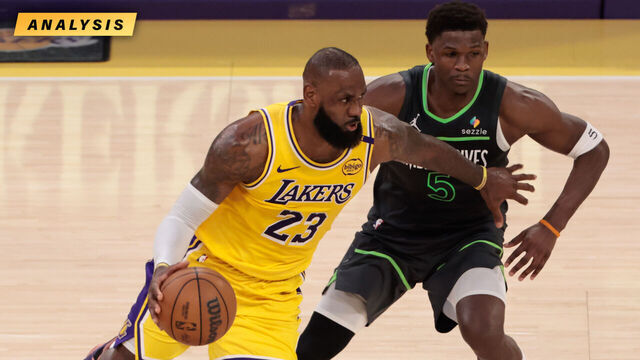
This summer represents the Lakers' best chance yet to build a more optimal roster around Luka Doncic, the franchise star around whom everything (and everyone) else orbits. Only the lowly Bulls have more cap space. The Lakers can give Austin Reaves roughly $40 million per year and still have another $30 million-$35 million to work with under the cap.
Of course, Los Angeles and LeBron James still need to make a potentially league-altering decision (his various options were covered here). In addition, Luke Kennard and Rui Hachimura are also unrestricted free agents. The former is a career 44% 3-point shooter who led the league in 3-point accuracy in three of the last five years, while the latter has overcome questionable decision-making by shooting 41% from deep (and nearly 57% inside the arc) over the last five years.
How much the Lakers are willing to give James, and how much they prioritize Kennard and Hachimura, will determine how flexible Los Angeles can be in pursuing a two-way, rim-running center (and which mid-level exception the team has access to). If James and at least one of Kennard or Hachimura return while the Lakers find a more Doncic-centric big man, contention is within reach.
Using their cap space isn't the only way the Lakers can make a splash. After this year's draft, they can trade and/or swap as many as five first-round picks (2028 swap, 2030 swap, 2031 first, 2032 swap, 2033 first).
Timberwolves
The Timberwolves fell two wins short of a third straight conference finals berth despite a number of postseason injuries and an inconsistent regular season. That's a testament to how playoff-ready this roster has been. Unfortunately, Anthony Edwards' squad might've already hit its ceiling.
Edwards and Jaden McDaniels form a fantastic two-way duo, but the Timberwolves are likely one star short, which is why Minnesota reportedly pursued Giannis Antetokounmpo at the trade deadline. However, whether they covet the Greek Freak or another big name, the Wolves' problem is that they're almost asset-starved. The only first-rounder Minnesota has left to offer is its 2033 pick (and swap rights in 2028 and 2032). Packaging that pick, salary filler, and the promising Terrence Shannon Jr. isn't likely to fetch a franchise-changer.
The first priority should be re-signing unrestricted free agent Ayo Dosunmu, even though that will send Minny into luxury-tax territory again. Dosunmu averaged 14.7 points on 62% true shooting for the Wolves (between the regular season and playoffs) after being acquired from Chicago at the deadline. Dosunmu's return is even more imperative given Donte DiVincenzo's recent Achilles injury.
Aside from the pursuit of a second star, the biggest question in Minnesota is what, if anything, the T-Wolves can do about their three-man rotation of bigs. Rudy Gobert remains a perennial Defensive Player of the Year candidate, and Julius Randle is a productive regular-season innings eater. But they've both faced their share of postseason issues, they're entering their age-34 and age-32 seasons, respectively, and they're still owed up to $144 million combined over the next two years (roughly 42% of the cap). Can the Wolves move one of them to clear a path for Naz Reid, who's been one of the league's best reserve bigs for what feels like forever?
76ers
The sheer talent at the Sixers' disposal gives them contending-level upside, but injuries and mistakes around the margins have prevented them from unlocking it. Philadelphia hasn't reached the East final since 2001. Will a new front office constructed by Bob Myers prioritize surrounding a brittle and expensive core with more depth, or will it turn the page on the Joel Embiid era to build around guards Tyrese Maxey and VJ Edgecombe?
If the 76ers choose the latter path, then their new executive faces a tough task in moving Embiid and/or Paul George, who are still owed nearly $300 million combined. If it's the former, Philly needs to get creative in its quest for depth. The best-case scenario would give the Sixers access to the $15-million non-taxpayer mid-level exception. They can put that to good use and also find a rotation player with the 22nd overall pick in this year's draft, but there would still be work to do. Philly also needs to make decisions on free agents Kelly Oubre Jr., Quentin Grimes, and Andre Drummond.
Joseph Casciaro is theScore's lead NBA reporter.