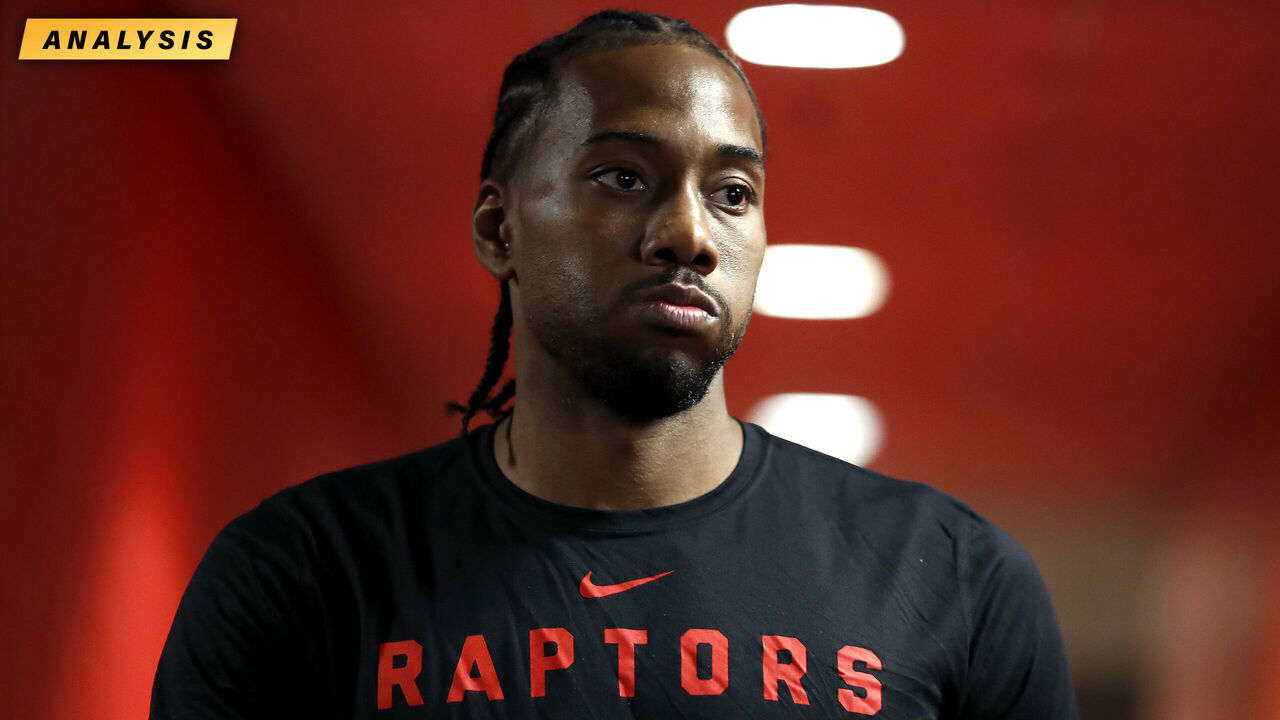
The king of the north has returned. The Los Angeles Clippers reportedly traded Kawhi Leonard back to the Toronto Raptors in exchange for Brandon Ingram, Gradey Dick, two first-round draft picks, a first-round pick swap, and two second-round picks.
| Raptors receive | Clippers receive |
|---|---|
| Kawhi Leonard | Brandon Ingram |
| Gradey Dick | |
| 2027 1st-round swap | |
| 2030 2nd-round pick | |
| 2031 1st-round pick | |
| 2033 1st-round pick | |
| 2033 2nd-round pick |
Let's break it down.
A no-brainer for Toronto
This transaction obviously carries risk for Toronto. Leonard has averaged just 55.5 games per season in the four years since returning from a torn right ACL. He already had a checkered injury history up to that point, and a cap-circumvention scandal still looms over him (and the Clippers). Relinquishing control of three first-rounders for such a player and giving him a max extension that will likely run through his age-37 season is not for the faint of heart.
But Raptors general manager Bobby Webster, vice president of health and performance Alex McKechnie, and the organization as a whole know what Toronto needs from Leonard and how best to manage the aging star. And the overall risk of the move is actually overstated.
Assuming Ingram eventually picked up his 2027-28 player option, the Raptors were on the hook to pay the one-dimensional star - who has missed more games than Leonard over the last four years - 24% of the salary cap for the next two seasons. Even if Leonard commands 35% of the cap over the next three years, going from two years of Ingram to three of Leonard is worth a few picks, especially when Toronto kept the rest of its rising core intact.
Ingram enjoyed a successful All-Star campaign north of the border until a heel injury led to a woeful postseason performance, but Leonard is in another stratosphere as a legitimate superstar. Consider the way Ingram's arrival addressed some of the Raptors' woes in the half court, and then consider that Leonard is an even better mid-range scorer, a more efficient offensive player, and a superior (and more willing) 3-point shooter.
| 2025-26 | PPG | RPG | APG | Stl+Blk | TS% | Honor |
|---|---|---|---|---|---|---|
| Leonard | 27.9 | 6.4 | 3.6 | 2.3 | 62.9 | All-NBA 2nd Team/7th-place MVP |
| Ingram | 21.5 | 5.6 | 3.7 | 1.5 | 57.3 | All-Star |
On top of all that, Leonard remains a game-changing defender, even if he's no longer a perennial Defensive Player of the Year candidate. And yet, he won't even be the best defensive player in Toronto's frontcourt, with Scottie Barnes and the budding Collin Murray-Boyles both capable of carrying that torch for years to come. The trio's potential at that end of the floor should terrify the rest of the league.
The Raptors acquiring a player of Leonard's caliber without trading Murray-Boyles is worth the draft capital in its own right. It's icing on the cake that they were also able to keep prospects like Ja'Kobe Walter, Jamal Shead, and recent first-round pick Allen Graves. Dick, who was drafted as an elite shooter but shot just 34% from deep over his first three years as a pro, had fallen out of the Raptors' rotation and their plans.
Barnes, Murray-Boyles, Walter, Shead, and Graves would've been a great foundation for the future even without Leonard. They still can be after the Raptors spend a few years contending with Leonard at the forefront. That's the kind of upside Toronto is suddenly staring at.
Even the team's higher-priced veterans look like better fits with Leonard in the fold. RJ Barrett, who's extension-eligible himself, can be an important off-ball threat and release valve for Leonard and Barnes, while his defensive shortcomings will be better masked on the other end. Meanwhile, starting point guard Immanuel Quickley's job just got easier. Rather than needing to justify his contract or a larger role, Quickley can simply act as a caretaker and shooter, especially if Barnes can touch the heights he did this spring as a point-forward.
The $103.6 million owed to center Jakob Poeltl, who was hampered by back issues last season, is still a problem. But the Raptors no longer have to view that deal as one that will impede their ability to pair Barnes with another star. They've landed that big fish in Leonard, and they're still deep enough to survive regular-season stretches without him.
The Raptors already boasted a top-five defense and an improved offense en route to 46 wins last season. Now they've essentially replaced Ingram with Leonard, which should provide a massive boost on both ends. Few teams will match Toronto's two-way ceiling. And perhaps no Eastern Conference team will be a bigger threat to the defending champion Knicks.
Grade: A
Clips did well given circumstances
The Clippers must be disappointed that after a seven-year run defined by postseason disappointment, injuries, and scandals - and after one of the best seasons of Leonard's career - the team couldn't acquire a blue-chip prospect when finally moving on from the future Hall of Famer. Such is life given all of Leonard's aforementioned baggage, plus the fact he was entering a contract year and had reportedly telegraphed that he'd only sign an extension with the Raptors.
Leonard's parting gift was seizing any leverage the Clippers may have had in trade negotiations. It's worth wondering if they could've called his bluff and commanded a better return from another suitor later in the offseason. That said, gaining control of three first-round picks - and delaying the unprotected picks until well after Leonard is gone - is fine work from president of basketball operations Lawrence Frank's front office.
As for next year's pick swap, the Clippers were set to receive the least favorable of Oklahoma City's pick or Denver's pick. As long as the Raptors finish behind one of the Thunder or Nuggets in the overall standings, the Clips will have improved their 2027 first-rounder.
Taking a flier on Dick, who desperately needed a change of scenery, could also prove beneficial. And Ingram should help Los Angeles stay somewhat competitive, which is important since the Clippers don't control their own first-rounder until 2030 (negating any incentive to tank).
As a team further from contention in the deeper conference, the Clippers were wise to allow another team to pay Leonard's next max contract rather than spinning their wheels and committing to the sunk-cost fallacy. It's time to turn the page in L.A., where Darius Garland, No. 5 overall pick Keaton Wagler, financial flexibility, and a slowly replenishing supply of draft capital can provide some light at the end of the tunnel.
The Clippers no longer have the ceiling they once did with Leonard and Paul George, Leonard and James Harden, or Leonard and whichever other veteran star cruised through town over the last seven years. But they have some clarity. That's worth something after a chaotic and ultimately unsuccessful era.
Grade: B+
Joseph Casciaro is theScore's lead NBA reporter.