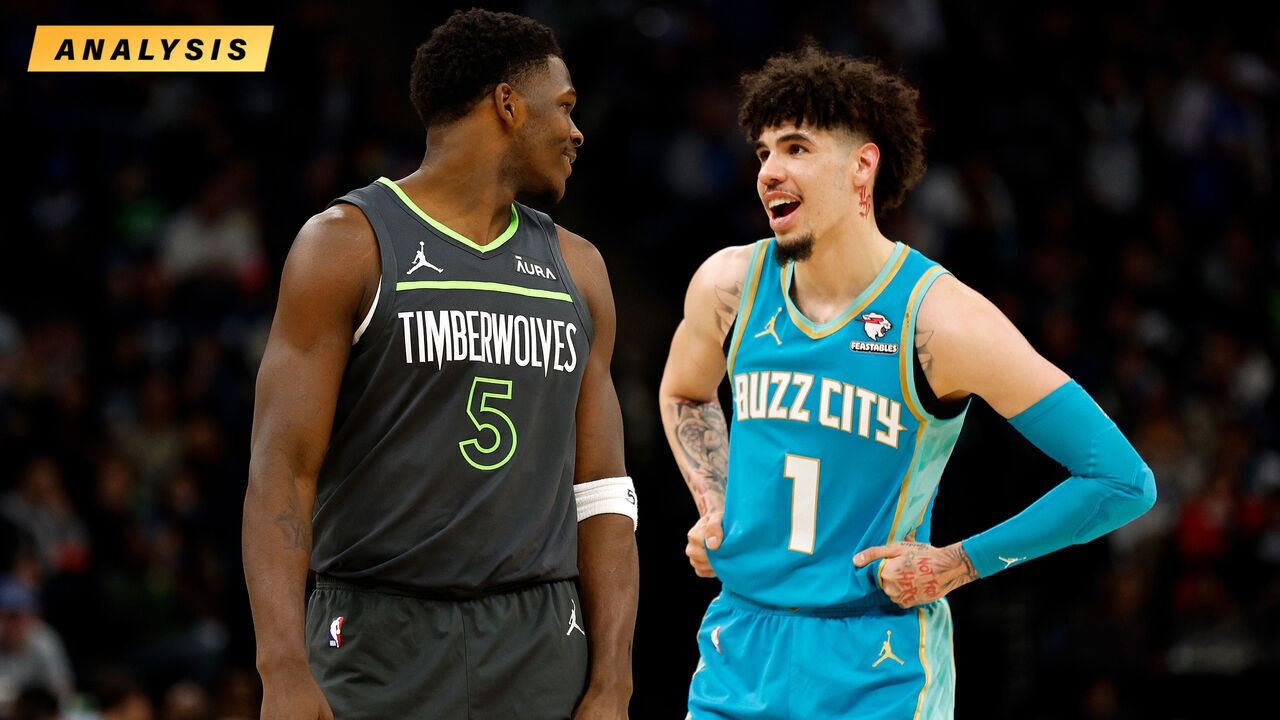
After one of the most exciting seasons in franchise history, the Charlotte Hornets reportedly traded star guard LaMelo Ball to the Minnesota Timberwolves. Let's break it down.
Wolves land costar for Edwards
For much of Anthony Edwards' career, the Timberwolves have surrounded the former No. 1 overall pick with a veteran cast of supporting stars, whether that be Karl-Anthony Towns, Julius Randle, or Rudy Gobert. In Ball, Edwards has a running mate born less than three weeks after him.
Of course, there's much more to this deal than Ball's age. At his absolute best, he's a game-breaking offensive talent with limitless range, top-tier playmaking skills, and the size to make a difference on the defensive end. Even with all his warts (and we'll get into those), Ball's impact on the Hornets' success was consistently positive. Among the 77 NBA players who logged at least 2,000 minutes last season, Ball's on/off differential of plus-9.9 ranked sixth, per Cleaning the Glass.
Edwards has never played with a backcourt mate this good, and it's easy to envision the pair forming a devastating offensive combination. There's also the recently re-signed Ayo Dosunmu, one of the league's best reserves and most efficient scorers last season. Whether Dosunmu starts alongside Ball and Edwards or continues to come off the bench, Minnesota will arguably boast the league's most talented crop of guards.
Turning Reid into Ball just days after trading Randle does somewhat throw off the team's balance. But between two-way stud Jaden McDaniels' ability to play small-ball power forward and Gobert maintaining his place as one of the best rim-protectors on the planet, the Wolves still have the bones of a solid defense.
If Josh Green can build off of his quietly solid season in Charlotte, he should be an efficient two-way reserve off the Wolves' bench. Minnesota's also got rising prospects Terrence Shannon Jr. and Joan Beringer, though the team needs to address its depth as the offseason progresses, especially in the frontcourt. That will be easier said than done: This week's deals once again made the Timberwolves a luxury-tax team and will almost surely make them a first-apron club as well. The moves also hard-capped the Wolves at the second apron, meaning Minnesota only has about $16 million to work with while trying to fill four roster spots.
Edwards and Ball are both under contract through 2029, but the Timberwolves are now pot committed to that star duo. In addition to the aforementioned financial constraints, Minnesota has one tradable draft pick remaining over the next seven years: Memphis' 2030 second-rounder. The only pick the Wolves control during that time is their own 2032 first-rounder, but the most they can do with it is offer it up as a swap.
In other words, Ball had better help Edwards win and stay in Minnesota.
Now about those warts ...
Thanks to a lengthy injury history, mostly involving his wonky ankles, Ball averaged just 47.4 appearances per 82 games over the first five years of his career. For the optimists pointing out that Steph Curry overcame ankle issues before exploding into superstardom, note that Curry still averaged 70 appearances per 82 contests over the first five "injury-prone" years of his career.
Even when healthy, Ball comes with baggage. Though he did play a smarter brand of basketball last season and made more of what coaches would describe as "winning plays" than he ever had before, his general demeanor remains unserious. His defensive effort is inconsistent, at best. And for all of the offensive talent Ball brings to the table, he's also prone to a startling number of baffling decisions with the ball in his hands. Not to mention, the kind of shot selection that leaves coaches with their heads in their palms.
Perhaps playing beside an alpha like Edwards, who should have the ball in his hands in the biggest moments, will help mitigate these issues. But there are off-court concerns, too. Notably, Ball has a reckless penchant for dangerous driving. The Hornets knew Ball better than anyone, and they decided to sell high on him rather than riding the wave of excitement last season produced. Even if you don't quite trust the Hornets as a franchise, the decision still says something about Ball.
The Timberwolves undoubtedly raised their ceiling and acquired the best player in the deal: a 24-year-old star. It's hard to knock that kind of splash. But Ball brings risk, and Minnesota didn't exactly buy low.
Grade: C+
Hornets make gutsy decision
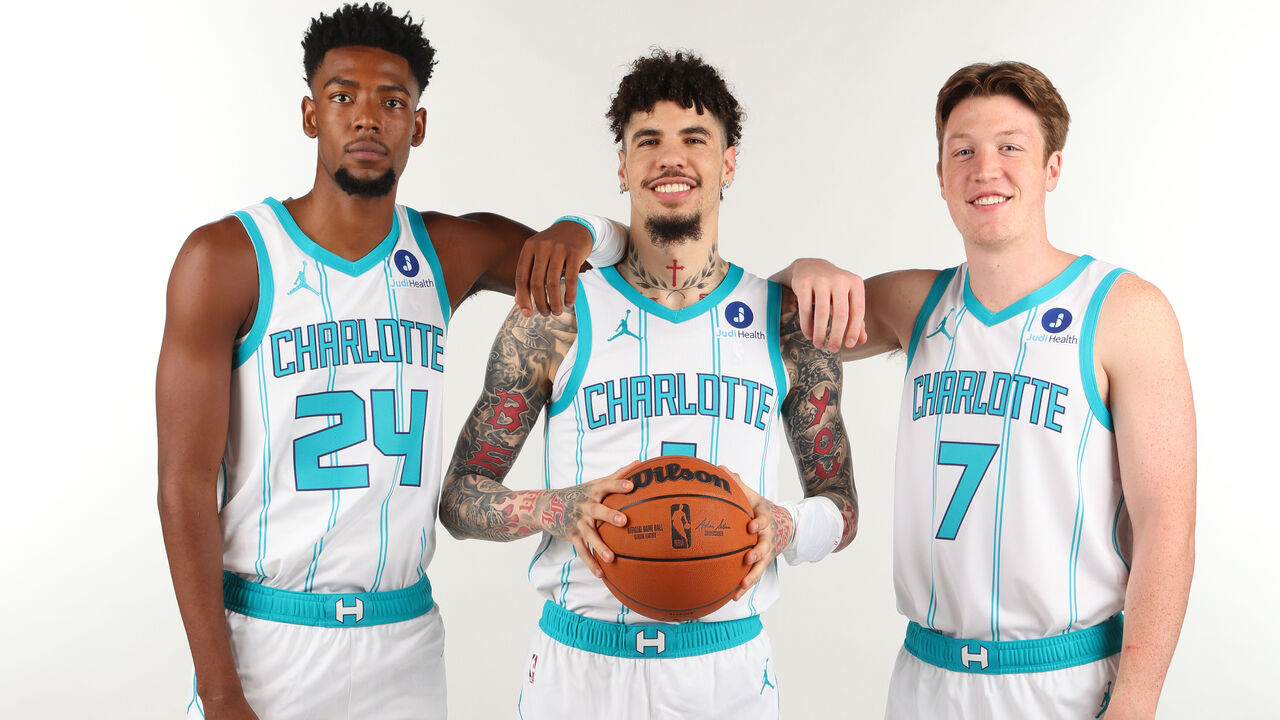
How you grade this deal for the Hornets is contingent on your belief in Ball. Either way, you have to admit that this trade took enormous guts.
Far too often, NBA executives make decisions - or are scared out of decisions - due to self-preservation. Plenty of front offices with the exact same long-term concerns about Ball would've stuck with the mercurial guard because they felt trapped by the feel-good story that the rising Hornets had become. Not Jeff Peterson, who has completely remade the Hornets in his two years as general manager.
Peterson's front office clearly felt Ball's value had reached its peak and acted accordingly. That decision was made easier by the presence of forward Brandon Miller and guard Kon Knueppel. The former's return from injury sparked Charlotte's remarkable midseason turnaround, while the latter's rookie season teased All-Star potential. No rookie has ever scored as many points as efficiently as Knueppel did. With Miller's combination of size and skill, and Knueppel's dizzying off-ball movement and prolific shooting, the Hornets already have the type of young duo many teams spend years tanking and wishing for.
Meanwhile, Moussa Diabate and Ryan Kalkbrenner look like promising big men, while recent first-round picks Hannes Steinbach and Christian Anderson join other intriguing youngsters like Sion James and Tidjane Salaun.
Reid can easily slot in as a starter after spending years as one of the league's best reserves. As a 26-year-old under long-term team control - who's set to earn less than 15% of the salary cap through 2030 - the big man can also serve as a valuable trade chip. The Hornets reportedly re-signed guard Coby White to a long-term deal as well, and they'll still have plenty of financial flexibility.
Perhaps most importantly, the ascendant Hornets now have 12 first-round picks over the next seven years, with control over a couple of Minnesota's first-rounders after the contracts of Edwards and Ball expire. Those could prove extremely valuable. Few teams, if any, can boast such draft capital. When combined with Charlotte's youth and cost-controlled talent, those assets put the Hornets in tremendous position to eventually acquire a star who's superior to Ball. That said, it's at least mildly disappointing that they couldn't squeeze a prospect or another impact player out of Minnesota.
Finally, being gutsy doesn't always mean being smart. Although trading Ball for Reid and a haul of picks is defensible, it could backfire. It's one thing if the Hornets take a step back in the short term but improve their big-picture outlook; it's another if Ball is immediately revealed to be the straw that stirred the drink. We're about to learn just how important - or how replaceable - he was.
Grade: B
Joseph Casciaro is theScore's lead NBA reporter.